
5 Ways FMCG Companies Can Use Technology to Improve Retail Execution
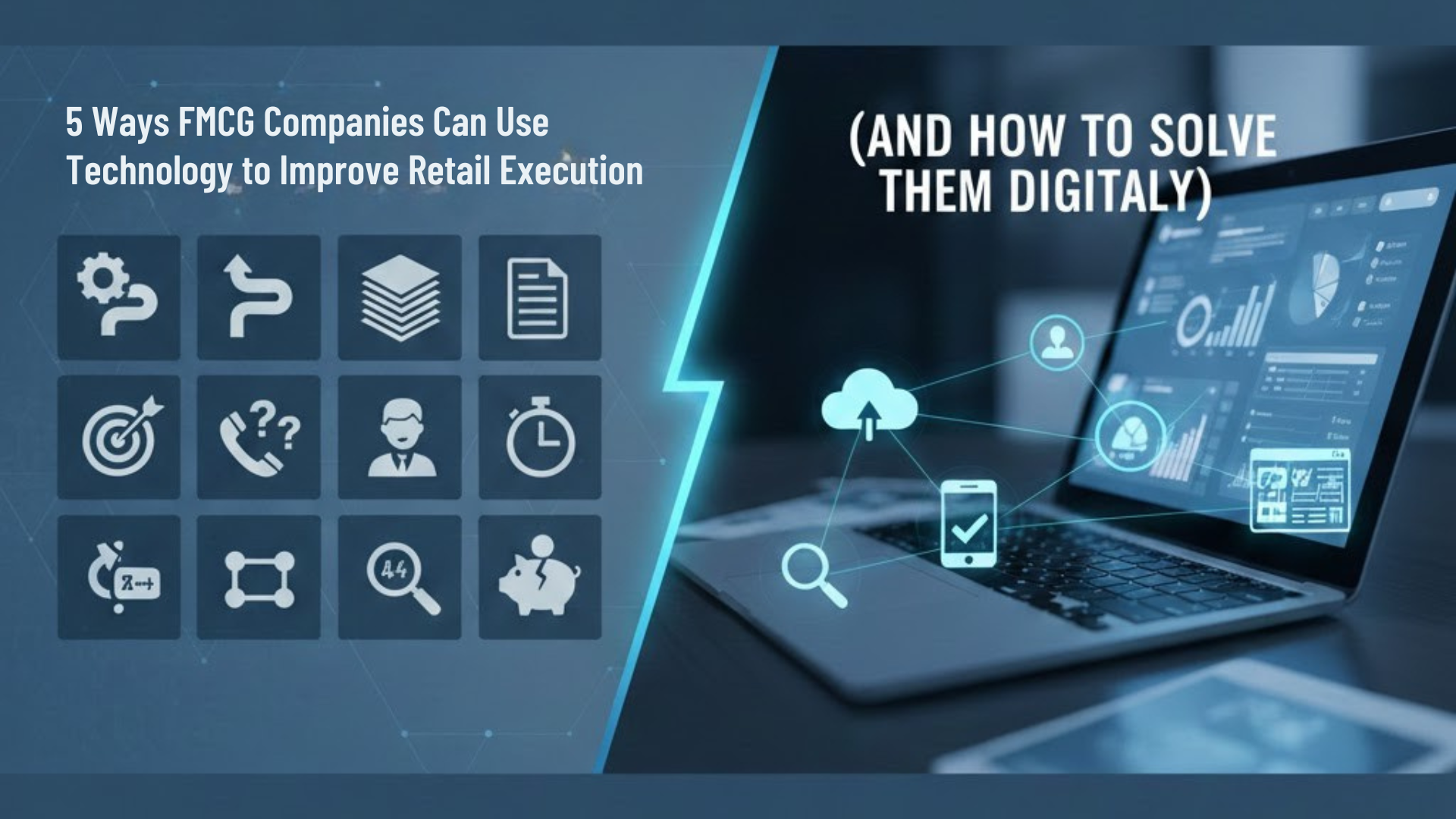
Fast-Moving Consumer Goods (FMCG) is a constantly growing domain with more brands and more products being added, almost every other day. Being a retail sector, execution is always one of those areas, where small gaps could lead to significant losses.
A missed stock-out, an incorrect planogram, or a delayed order might look minor on a dashboard, but in the FMCG world, it translates into lost visibility on the shelf and lost revenue, which competitors might take advantage of!
But there is good news!
The arrival of Artificial Intelligence (AI) in retail and automation in the FMCG sector is changing how companies operate not only internally, but also at store level. 5 Ways Technology in FMCG Retail Sector Helps Bring Improvement
At Manacle, we have created an AI-integrated suite of tools, which includes sales force automation, human resource management, enterprise resource management. With these in hand, FMCG companies can strengthen retail execution and keep performance consistent across markets. Here are 5 practical ways in which technology in FMCG retail can work:
1. Strengthening on-shelf availability with visibility - One of the fastest ways to lose market share is for products to be out of stock. The problem isn’t just replenishment delays - it’s the lack of timely data from the field. Reducing stockouts in retail with technology means that your team can log stock levels, shelf gaps, and order requirements instantly. When you can sync this data in real-time, supervisors and distributors can respond before the customer encounters an empty shelf. In addition, AI-integrated solutions such as ours can help identify recurring stock-out patterns, predict future shortages, and suggest preventive actions based on store behaviour and sales history.
2. Using image recognition to improve accuracy in merchandising - Although planogram compliance might be essential, manual checks are often slow, inconsistent and prone to errors. When photos get exchanged on messaging apps, validation often becomes subjective and unreliable. However, with effective and efficient digital tools for FMCG merchandisers, the workflow can be changed. By using image recognition, field teams can capture a shelf photo, and the system will instantly flag missing SKUs, incorrect placements, pricing errors, or competitor intrusion. Not only does this reduce the time spent auditing shelves, but also brings discipline to execution. Your managers will have a unified, visual view of compliance across territories, without relying on manual interpretation.
3. Streamlining order capture and replacement - Order-taking is often the weakest link in the retail chain, because most field teams rely on handwritten notes, phone messages, hurried calculations, or even outdated product lists. This leads to underordering, missed SKUs, and inconsistent demand visibility. If your aim is enhancing brand visibility in stores with tech, you need to bring digital order capture modules into action. These can provide updated catalogues, automated suggestions, and smart quantity recommendations based on past store behaviour and current stock levels. AI-integrated retail execution technology solutions, such as forecasting tools, can help bridge the gap between field demand and back-end supply planning, reducing both overstocking and shortage issues.
4. Enhancing field productivity with route and task automation - FMCG field teams face packed daily schedules - multiple stores, different priorities, and shifting targets. Poor planning translates into wasted hours and uneven coverage. AI-backed route optimisation reorganises the day for maximum impact. It creates efficient visit sequences, reduces travel time, and ensures stores with higher sales potential receive the right amount of attention. Moreover, task automation can send reminders, send team members more often to priority stores, and generate instant visit reports, reducing the load on the entire team.
5. Unifying reporting with consistent feedback - Most organisations still struggle with reporting that is too scattered. Sales updates come from one tool, merchandising photos from another, attendance from a third, and HR activities from a fourth. It is not surprising that important insights get lost in this convoluted process. Invest in a unified digital platform for your FMCG retail execution needs and you will have a single source for almost everything. Imagine a single ecosystem that houses attendance, tasks, merchandising, orders, expenses, and performance! At Manacle, we have this ecosystem ready for you – our AI-integrated solutions connect all the dots for you, giving you real time data, analytics and insights.
What Do These Retail Execution Technology Solutions Mean For Companies?
When technology sits at the center of retail execution, teams move with greater precision. Team members spend less time on manual tasks and managers can stop chasing information. Supply chain decisions become faster and every store visit produces actionable insights, not just activity logs.
If the goal of your company is to increase availability, tighten merchandising, and raise productivity across your field force, then you need to shift to a tech-enabled retail execution model today!
You need to shift to Manacle!
Written by
Manacle Insiders
Related Articles
How to Measure Field Sales Productivity: 7 KPIs Every Sales Manager Should Track
Here’s a question most sales managers can’t answer without hesitation: How productive is your field team, really? Not busy. Not “on the road.” Productive. In FMCG, where field sales teams are large, geographically dispersed, and moving fast, the difference between activity and output is where most revenue leakage hides. Reps can be clocking 10-hour days and still miss coverage targets. They can be visiting outlets every week and still lose shelf space to a competitor. The problem isn’t effort, it’s visibility. If you’re relying on daily call reports, WhatsApp updates, or gut instinct to assess your team’s performance, you’re managing blind. A proper sales activity tracking software India, along with the right metrics will help you in the long run. Here are the 7 major metrics that every sales manager should track to measure sales productivity.

Top 10 Challenges in Field Sales Management (and How to Solve Them Digitally)
Field sales management's core difficulties—like inaccurate data and inefficient routes—are overcome by switching to AI-integrated digital solutions. This results in real-time visibility, automated reporting, and a consistent customer experience across a scaling team.
How Sales Force Automation Is Transforming FMCG Distribution In India
FMCG growth is rising, but old-school operations slow everything down. SFA brings real-time data, faster orders, stronger distributor control and sharper store execution. It turns guesswork into clear action. If you want smarter decisions and tighter performance, SFA is the shift you need.